Less retyping. More time for patients.
Workflow automation, AI admin assistants, AI scribes set up within TGA and Ahpra guidance, an AI use policy and reports that build themselves. Practical, governed and approved by you.
Automate the repeatable. Keep people for the rest.
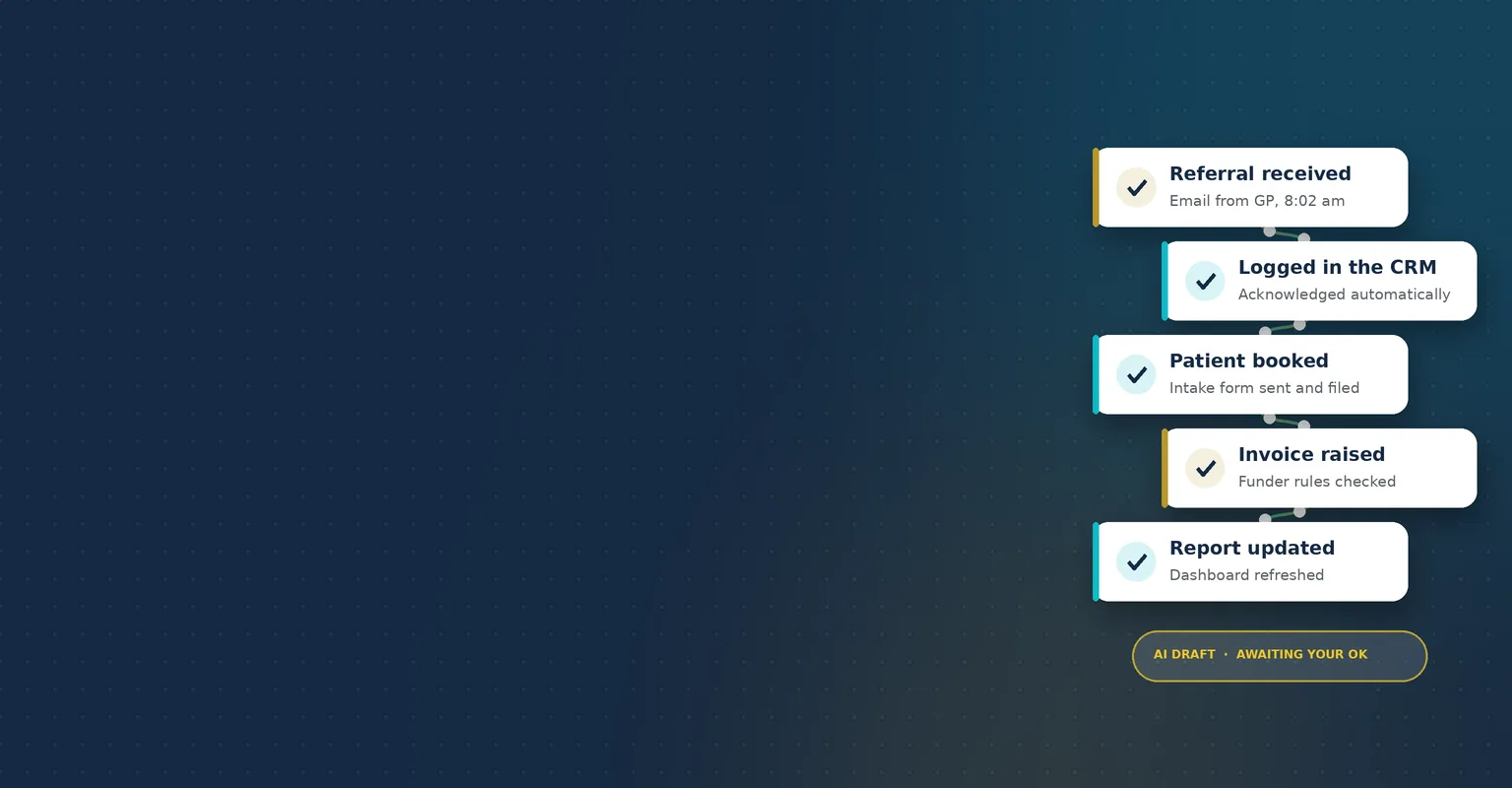
Most practice admin is the same steps on repeat: a referral arrives, someone retypes it, chases the paperwork, books the patient, sends the invoice and builds the report. Every hand-off is a chance for delay or error, and it eats the hours your team should spend with patients.
We automate the repeatable parts and add AI where it genuinely helps, with guardrails: practitioners stay accountable, patients are told when AI is used, and nothing goes out in your name without a person approving it. We run the same kind of automations in practices we operate ourselves.
Who this is for
- Practices where admin cannot keep up with referrals
- Practices adopting AI scribes or AI assistants
- Owners who want reports without building spreadsheets
- Practices whose tools do not talk to each other
How we help
Automation review
We find where your team retypes, copies and chases, and what can safely be automated.
We map the path from first enquiry to paid invoice: who does what, in which system, and how long it takes. Then we list what can be automated, what AI could help with, what should stay manual and the risks of each.
You get a short, ranked plan with the time each change should save, so you can start with the changes that pay back fastest.
Workflow automation
Referrals, forms, reminders, recalls and hand-offs that run without retyping.
We build automations with tools such as Microsoft Power Automate, HubSpot workflows and Snapforms, connected to your practice software where it allows: referrals logged and acknowledged, intake forms filed, reminders and recalls sent, tasks routed to the right person.
Every automation is documented, tested and has a named owner, so it keeps working when staff change.
AI admin assistants
AI that drafts, sorts and summarises, with a person approving every message.
AI assistants can sort a shared inbox, summarise long referral letters, draft routine correspondence and prepare a daily briefing of what needs attention.
They draft; people decide. Nothing is sent to patients, referrers or funders without approval, and no clinical decisions are made by AI.
AI scribes, set up safely
Choosing, configuring and governing an AI scribe within TGA and Ahpra guidance.
Under the TGA’s digital scribe guidance, a scribe that only transcribes or summarises what the practitioner says is generally not a medical device, but one that suggests a diagnosis or treatment the practitioner did not state is, and must be included in the Australian Register of Therapeutic Goods. The TGA has found that many popular scribes have functions likely to meet that definition.
We check a scribe’s regulatory status, privacy terms and data location, set up patient information and consent, and build a simple step for checking notes before they are finalised.
AI policy and staff training
A short, practical AI use policy and training your team will actually follow.
Ahpra’s guidance on AI says practitioners remain responsible for their practice when they use AI. We write an AI use policy that covers approved tools, consent, privacy, checking AI output and record-keeping, and train staff on what is and is not allowed.
From 10 December 2026, privacy policies must explain certain automated decisions that use personal information. We make sure your privacy policy matches what your systems actually do.
Automated reporting and dashboards
Referrals, bookings, billing, debtors and capacity, updated without spreadsheets.
We connect your practice software, CRM and accounts to a simple dashboard: referrals in and booked, wait times, billing by funder, money owed and clinician capacity.
Reports arrive on a schedule, so owners and practice managers see problems early instead of at the end of the quarter.
Usually part of
AI & Automation questions
Can AI and automation be used safely in a medical or allied health practice?
Yes, with guardrails. Ahpra’s guidance says practitioners remain accountable when they use AI, so output is checked by a person, patients are told when AI is used, and tools are chosen with their privacy terms and regulatory status in mind. Routine automation, such as logging referrals or sending approved reminders, carries far less risk than AI that touches clinical decisions.
Are AI scribes medical devices in Australia?
It depends on what they do. The TGA’s guidance says a digital scribe that only transcribes or summarises a consultation is generally not a medical device, but one that generates a diagnosis or treatment recommendation the practitioner did not state is a medical device and must be included in the Australian Register of Therapeutic Goods. We check this before recommending any scribe.
Do patients need to consent to an AI scribe?
Practitioners should tell patients when they plan to use an AI scribe and give them enough information to make an informed choice, including how their information is handled. We set up patient information, a consent step and a record of the patient’s decision.
Will automation replace our admin staff?
Usually not. It removes retyping and chasing, so your team can spend more time with patients, referrers and the exceptions that need judgement. Many practices use the time saved to absorb growth without hiring.
Which tools do you use for automation?
We start with what you already pay for. Common choices are Microsoft Power Automate, HubSpot workflows, Snapforms and the integrations built into your practice software. We are not a reseller and take no commissions.
Often combined with
Not sure where to start?
Every engagement starts with a Practice Health Check, so we fix what matters most first. Book one, or take the free 3-minute self-check.